Why Your Team Spends 30% of the Working Week Searching for Information — And What's Structurally Wrong
In 2012, McKinsey found knowledge workers spend 1.8 hours per day searching for information. IDC revised the cost to $14,000 per worker per year. The problem is structural — and it won't be fixed with another wiki.
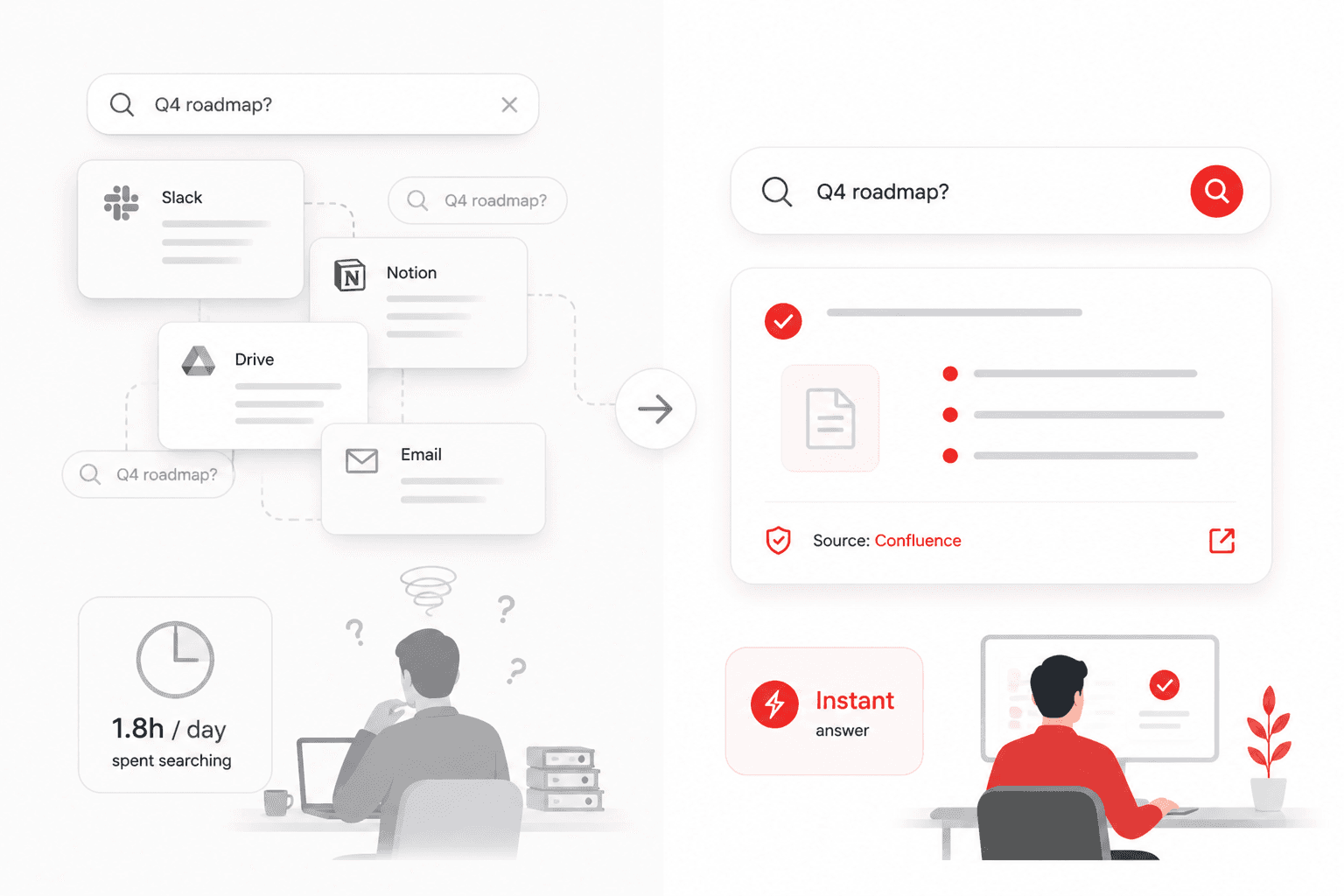
In 2012, McKinsey published a study that found knowledge workers spend approximately 1.8 hours per day — 22% of the working week — searching for and gathering information. A decade later, IDC revised this upward, estimating the cost at $14,000 per knowledge worker per year in lost productivity.
Most leaders who encounter these statistics do one of two things. They dismiss them as too high to be credible. Or they accept them and conclude the problem is cultural — that staff need to document better, communicate more clearly, or use tools more effectively.
Both responses are wrong. The problem is structural. And the structural fix is not more documentation tools.
The fragmentation paradox
Here is the counterintuitive reality of modern knowledge management: the more tools an organisation uses to store and share information, the harder it becomes to find anything.
A typical mid-market organisation in 2025 stores knowledge across 8–12 different tools. Engineering uses Confluence, GitHub, and Notion. Sales uses Salesforce, Google Drive, and Slack. HR uses SharePoint and BambooHR. Finance uses SharePoint and email. Customer support uses Zendesk Guide and Confluence.
Each tool was introduced to solve a specific problem. Each one does its job reasonably well within its own boundary. But the knowledge a person actually needs to answer a question rarely lives cleanly within one tool's boundary. It lives partly in Confluence, partly in a Slack thread from six months ago, and partly in a Google Doc that someone created before the Confluence wiki existed.
This is the fragmentation paradox. More tools means more places for knowledge to be captured. But it also means more places to search, more systems to navigate, and a higher probability that the answer a person needs exists somewhere they haven't looked yet.
Adding another knowledge management tool to solve a knowledge fragmentation problem is like adding another filing cabinet to solve a filing problem. The documents are now stored in more places. They are not easier to find.
The four failure modes of fragmented knowledge infrastructure
Knowledge fragmentation manifests in four distinct, measurable ways. Understanding which ones apply to your organisation is the first step toward addressing them with the right solution.
Failure mode 1: Tribal knowledge dependency
When documented answers cannot be found reliably, the path of least resistance is to ask someone who knows. Senior employees become the de facto knowledge index for their organisation — a role that consumes significant time and creates a single-point-of-failure for operational knowledge.
The measurable cost: an engineering manager interrupted three times per day with questions that have documented answers loses approximately 45 minutes of deep work daily — time that compounds across a year into roughly 150 hours of strategic capacity consumed by answerable questions.
Failure mode 2: Version confusion
Documentation exists in multiple versions across multiple tools with no reliable way to determine which is current. An employee who finds a returns policy in Google Drive has no way to know whether it was updated in SharePoint last month. A new engineer who finds the deployment runbook in Confluence cannot confirm whether it reflects the current infrastructure.
This failure mode is particularly costly in regulated industries where acting on an outdated compliance document carries legal risk — and in fast-moving technology environments where operating procedures change faster than documentation is updated.
Failure mode 3: Onboarding friction
New hires enter an organisation with no mental map of where knowledge lives. The first 30–60 days of employment are characterised by a disproportionate share of the colleague interruption costs described above — new employees ask more questions, interrupt more frequently, and are less productive per hour for longer than necessary.
McKinsey research found that organisations with searchable, well-structured knowledge records reduce new hire ramp time by up to 35%. That is not a marginal improvement — at the salary levels of knowledge workers, a 35% reduction in ramp time represents a material commercial return on the search infrastructure investment.
Failure mode 4: The knowledge gap — what you don't know you don't have
The most insidious failure mode is invisible: employees regularly search for information that does not exist in any tool, in any form. They search for it, fail to find it, and assume it is somewhere they haven't looked. The question goes unanswered or the colleague gets interrupted again.
Without search analytics that surface failed queries — searches that returned no results or no clicks — there is no systematic way to know what documentation gaps exist. The organisation cannot invest in creating knowledge it does not know is missing.
Why more wikis don't solve this
The instinctive response to knowledge fragmentation is to create a single canonical wiki — a Confluence space, a Notion workspace, a SharePoint intranet — and migrate all knowledge into it. Teams spend weeks on migration projects. Documentation standards are established. A dedicated knowledge manager may be hired.
Within 12 months, the problem returns. Here is why.
People create knowledge where they are working, not where it is supposed to live. An engineer debugging a problem creates a Slack thread with the solution. A sales manager shares a new battlecard in Google Drive because it's faster. A product manager documents a decision in the meeting notes doc rather than copying it to the wiki.
The wiki remains the official location for knowledge. The actual knowledge accumulates everywhere else. A single-destination strategy does not survive contact with how people actually work.
The goal is not to move knowledge into one place. The goal is to make knowledge findable wherever it was created.
What unified AI search actually fixes — and what it doesn't
Unified AI search addresses the retrieval problem — the inability to find knowledge that exists — across whatever tools your organisation uses. It does not fix the creation problem. If knowledge was never documented, search cannot surface it.
What it does fix, specifically: a query asked in natural language returns the most relevant answer from across every connected tool, cited to its exact source and version, in under 10 seconds. The employee does not need to know which tool the answer lives in. They do not need to remember a document title or a folder structure. They ask a question and get an answer.
The knowledge gap report — a feature of properly instrumented knowledge search — then surfaces what cannot be answered. These are the documentation investment priorities. The organisation can systematically close gaps identified by real employee search behaviour rather than guessing what documentation is missing.
The cost at your scale
Using IDC's $14,000 annual figure (adjusted conservatively to $10,000), the annual cost of knowledge fragmentation at different organisation sizes:
| 50 people | $500,000/year in knowledge friction costs |
| 100 people | $1,000,000/year |
| 200 people | $2,000,000/year |
| 500 people | $5,000,000/year |
| 1,000 people | $10,000,000/year |
These are not speculative figures. They are the product of documented research on how knowledge workers spend their time, applied to real salary costs. The question is not whether this cost exists in your organisation. The question is what fraction of it is recoverable with the right infrastructure.
Your knowledge fragmentation cost is a line item in your operating budget. It just doesn't appear on any report — because nobody has calculated it yet.
Five questions to assess your knowledge fragmentation
Before investing in any solution, it is worth understanding the scale of the problem in your specific organisation.
| How many tools store knowledge? | More than 5 is fragmented. More than 8 is critically fragmented. |
| Can a new hire self-serve on day one? | If no, your onboarding is dependent on colleague availability. |
| Do you have a unified search? | If staff search each tool separately, retrieval time is multiplied by tool count. |
| How often are senior staff interrupted? | Daily interruptions from documented questions are the most measurable signal. |
| Do you know your knowledge gaps? | If you cannot identify what's missing, you cannot systematically close gaps. |
→ Find your Knowledge Access Score — free assessment in 2 minutes